
Veda-Trained Pandits
Experienced pandits guide the ceremony with care for your family’s tradition.
Pooja booking
Original price was: ₹15,000.00.₹11,000.00Current price is: ₹11,000.00.
Per pooja
Applicable taxes are shown in your booking. Optional additions are separate.
Exclusions
Thoughtfully arranged, personally guided
Experienced pandits guide the ceremony with care for your family’s tradition.
Stay in touch with our team for your booking details and ceremony arrangements.
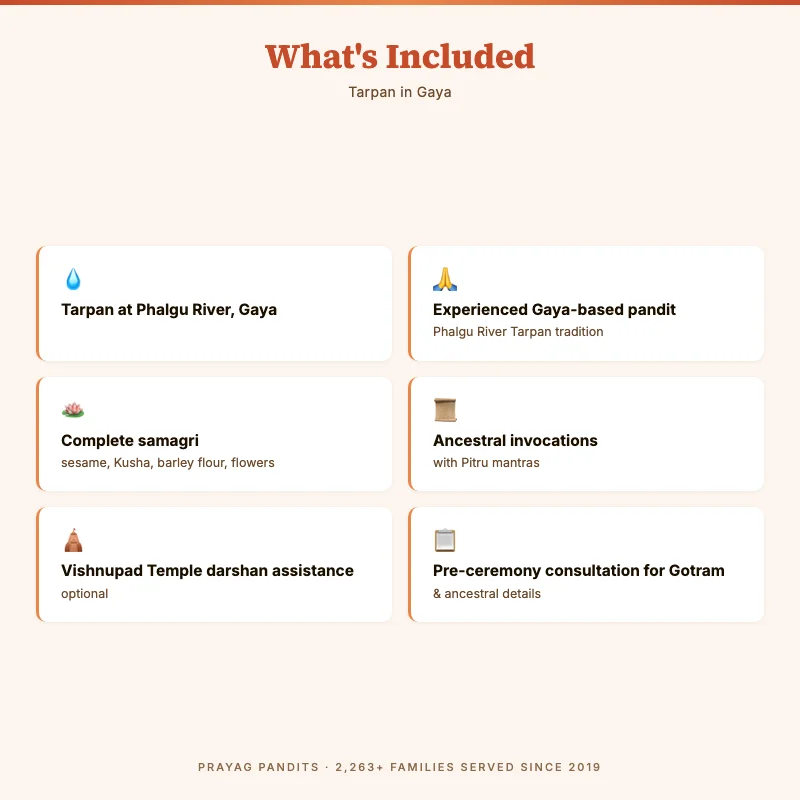
See what your selected package includes. Optional additions are shown separately.
Share the date and timing that suit you. Our team confirms the final arrangements.
Experiences shared by our families
30 family reviews22 for this pooja · 8 from across our services
हमने अपने पिता जी के श्राद्ध के लिए यह सेवा बुक की थी। पंडित जी बहुत अनुभवी थे और सभी विधि-विधान शास्त्रोक्त तरीके से करवाए। सामग्री की व्यवस्था भी उन्होंने ही की। बहुत अच्छा अनुभव रहा।
We had been wanting to perform Pind Daan for years but couldn’t travel to India. This online service was a blessing. The entire ritual was done as per shastras. Thank you Prayag Pandits team for your dedication. Dhanyavaad.
बहुत ही professional और भक्तिपूर्ण सेवा। सारी सामग्री included थी। Recommend करता हूँ।
पहली बार ऑनलाइन बुकिंग की थी, लेकिन अनुभव बहुत अच्छा रहा। पूजा पूरी विधि-विधान से हुई।
Five stars for sure. The team was responsive to all our queries before and during the ceremony.
Quick booking, prompt response, and excellent execution. We were a group of 6 family members and everything was managed well. The pandit was respectful and the ceremony felt genuine. Dhanyavaad.
ऑनलाइन पिंडदान का विकल्प हमारे जैसे NRI परिवारों के लिए वरदान है। वीडियो कॉल पर सब कुछ स्पष्ट दिख रहा था और हम पूजा में भाग ले सके। पंडित जी ने धैर्य से सब कुछ समझाया।
तीसरी बार प्रयाग पंडित्स से सेवा ली। हर बार सेवा उत्कृष्ट रही। पंडित जी का व्यवहार बहुत अच्छा है और वे पूजा को पूरी श्रद्धा से करवाते हैं। Jai Shri Ram.
We are NRI family based in USA. We booked online poojan and it was conducted very sincerely. The video quality was good and we could see everything clearly. The team sent us photos and videos after the ceremony too. Om Shanti.
We are NRI family based in USA. We booked online poojan and it was conducted very sincerely. The video quality was good and we could see everything clearly. The team sent us photos and videos after the ceremony too.
Thoroughly impressed with the professionalism. The pandit ji was punctual and well prepared with all the samagri.
खूप छान सेवा. पंडितजींनी सर्व विधी व्यवस्थित केली. अतिशय समाधानी आहे.
Outstanding service for Pind Daan. The pandit arrived early, set up everything neatly, and began the ceremony right on time. His pronunciation of Sanskrit shlokas was impeccable. Very authentic experience. Dhanyavaad.
We booked this for our grandfather’s annual shradh. The ceremony was performed with great reverence. Pandit ji even shared stories from the Garuda Purana which were very enlightening for the younger generation. Dhanyavaad.
Very professional service. The pandit ji explained every step of the ritual which helped us understand the significance. Everything was arranged well including the samagri. We are grateful to Prayag Pandits for making this spiritual journey meaningful.
We are NRI family based in USA. We booked online poojan and it was conducted very sincerely. The video quality was good and we could see everything clearly. The team sent us photos and videos after the ceremony too. 🙏
We are NRI family based in USA. We booked online poojan and it was conducted very sincerely. The video quality was good and we could see everything clearly. The team sent us photos and videos after the ceremony too. Jai Shri Ram.
প্রয়াগ পণ্ডিতস-এর সেবা খুবই ভালো। সব ব্যবস্থা সময়মতো হয়েছিল।
First time performing Pind Daan and was nervous about the process. But the team guided us well. They explained what to wear, what to bring, and what mantras to recite. Everything went smoothly. 🙏
Excellent experience. We were worried about how to perform Pind Daan from abroad but the online option made it possible. The live video call was clear and we could participate in real time. The pandit was patient and answered all our questions.
YOUR EXPERIENCE MATTERS
Tell us about your ceremony and the support you received. Your email address will stay private.
From your first choice to your booking
Review your package and any available additions, then add it to your booking.
Enter your contact details, preferred date and time. Add ancestral details if you wish.
Our team confirms the arrangements and shares your coordinator’s details 24 hours before the pooja.
Follow the participation and joining arrangements described in your package and shared by your coordinator.
Gaya occupies a singular position in Hindu ancestral tradition. The city on the banks of the Phalgu River in Bihar is the one place in India where the scriptures say that Pind Daan and Tarpan bring the most direct and permanent liberation to departed ancestors. The Valmiki Ramayana describes Lord Rama himself performing Pind Daan for his father Dasharatha here. The Mahabharata records that Yudhishthira traveled to Gaya after the Kurukshetra war to perform the ancestral rites for the warriors who had fallen. Gaya is not simply a sacred city — it is the tirtha that Hindu tradition has specifically designated for the salvation of ancestors, and that designation has held for thousands of years.
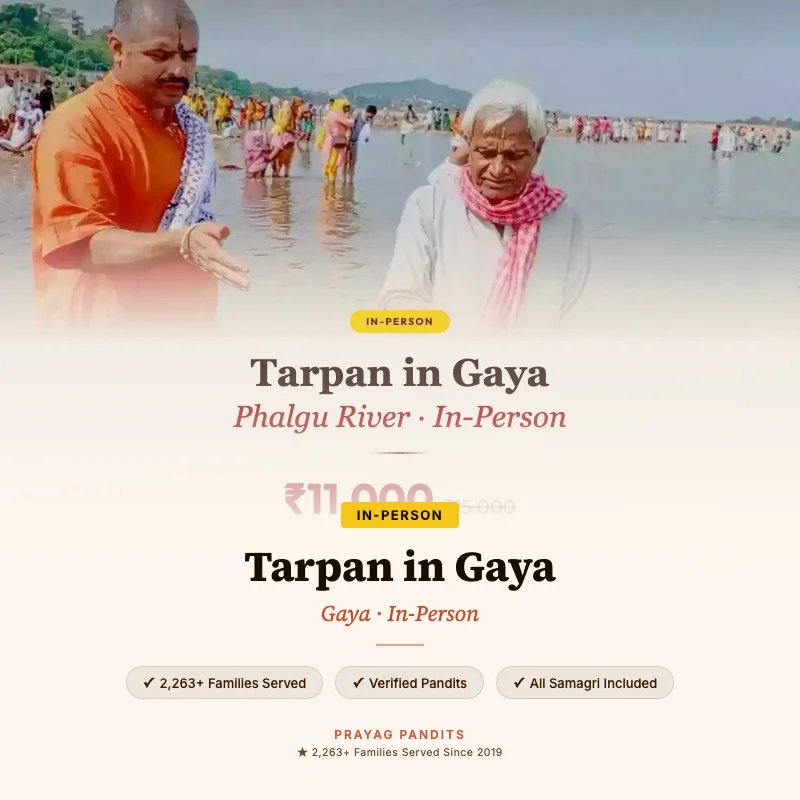
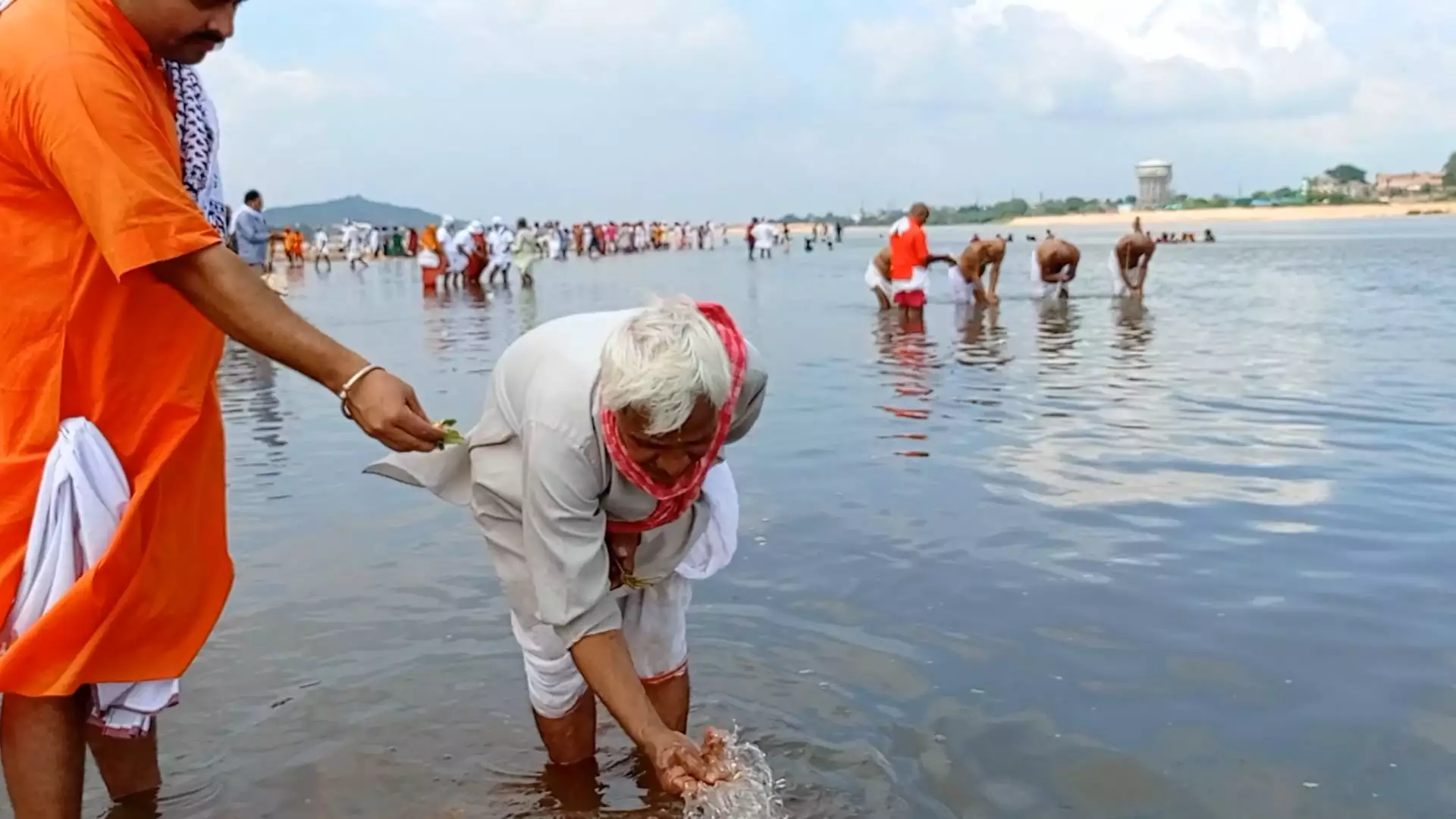
Tarpan — the offering of water mixed with sesame seeds and sacred materials to departed ancestors — is one of the primary rites performed at Gaya, and it can be performed here throughout the year. This service is for those who wish to come to Gaya in person, stand at the bank of the Phalgu River, and perform Tarpan with their own hands under the guidance of our experienced pandit. There is no restricted season for this ceremony — you can book it at any time of year that works for you.
Many people use the terms Tarpan and Pind Daan interchangeably, but they are distinct rites with different forms and, within the tradition, different functions. Understanding the difference helps you approach the ceremony with clarity.
Tarpan is the act of offering water. The Sanskrit root tarp means to satisfy, to quench, to nourish. In Tarpan, the officiant holds cupped hands over a water body, fills them with water mixed with sesame seeds, Kusha grass, and sometimes milk or barley flour, and releases the water in a steady stream while reciting the names of departed ancestors and specific mantras. The water offering is understood to nourish and satisfy the ancestral souls, easing their journey through the afterlife realms.
Pind Daan goes further. A Pind is a rice ball — physically formed from cooked or flour-based rice mixed with sesame, honey, and other prescribed ingredients. The Pind represents the body of the ancestor and is offered as a symbolic act of providing sustenance across the threshold of death. Pind Daan is considered a more elaborate and comprehensive rite and is typically the centerpiece of Pitrupaksha and Gaya pilgrimages.
For more background on both rites and how they relate to each other, our detailed article on everything you need to know about Pind Daan provides a thorough overview of the ancestral rite tradition.
This service focuses on Tarpan as performed at the Phalgu River in Gaya. Tarpan can be performed as a standalone rite or as part of a broader ancestral ceremony sequence. Many families perform Tarpan at Gaya annually as an ongoing act of devotion to their forebears, in addition to or independently of full Pind Daan ceremonies performed at major pilgrimage times like Pitrupaksha.
The Phalgu River has a reputation in Hindu tradition that is both sacred and poignant. The river is unusual in that for much of the year, particularly in the dry season, its surface appears sandy and dry — the water flows beneath the sand rather than above it. This underground quality has given the Phalgu a mythological depth that ordinary rivers do not have.
According to the Ramayana, when Lord Rama visited Gaya to perform Pind Daan for his father, Sita Mata was present with him. At one point, Rama went to gather ritual materials, leaving Sita at the riverbank. The soul of King Dasharatha appeared and asked for Pind Daan immediately. Sita performed the Pind Daan herself, using the river sand as the Pind. When Rama returned, the ritual had already been completed — and the river itself, the sand of the Phalgu, and the Akshayavat tree at the site bore witness to what had occurred.
This story carries an important doctrinal point: the Phalgu River at Gaya is understood by the tradition to have the capacity to witness and validate ancestral offerings even when the physical form of the rite departs from the standard. The river’s depth — its invisible, underground flow — is seen as a metaphor for the invisible but real channel between the living and the departed. Tarpan performed here is offered not just into visible water but into a sacred underground current that the tradition understands to reach the Pitrs directly.
Pitrupaksha is the most widely observed time for ancestral rites across India, but Gaya is one of a small number of tirthas where the tradition explicitly endorses ancestral rites throughout the year. The Gaya Mahatmya — the scriptural compendium on Gaya’s virtues — states that any day at Gaya is auspicious for Pind Daan and Tarpan. This is because Gaya’s sanctity for ancestral rites does not depend on a seasonal window; it is inherent to the place itself.
The practical advantages of this are significant. Gaya during Pitrupaksha is extremely crowded, and the logistical and emotional experience of the fortnight is intense. Many families prefer to come to Gaya outside of Pitrupaksha — when the ghats are quieter, the pandits have more time to give personal attention, and the journey itself is less demanding. The ceremony is equally valid and the location is equally potent.
Common occasions that bring families to Gaya throughout the year include:
Gaya is a city that reveals itself slowly. It does not have the visual grandeur of Varanasi or the scale of Prayagraj, but it has a quality of spiritual concentration that experienced pilgrims recognize immediately. The Vishnupad Temple at the center of the city — built around the footprint of Lord Vishnu imprinted in solid rock — is the spiritual heart of the pilgrimage. The Phalgu River flows past the temple ghats, and the series of Pind Daan sites — the 45 Vedis where rites are performed in sequence — stretch along the riverbank and through the city.
Being physically present for Tarpan at Gaya means kneeling or sitting at the riverbank with your pandit, your hands in the water or the wet sand, releasing the Tarpan offering with your own hands while the mantras are recited. The sensory experience of the ceremony — the feel of the water, the smell of sesame seeds and marigolds, the sound of the river even when it appears dry on the surface — is part of its meaning. You are present in the same physical space where Rama performed this rite, where countless generations of your ancestors’ descendants have come to honor those who came before them.
There is a continuity in physical pilgrimage that digital participation, however meaningful in its own context, does not replicate. Coming to Gaya in person is a statement — to your ancestors and to yourself — that the obligation is worth the journey.
Gaya is accessible by rail (Gaya Junction is a major station on the Grand Chord line) and by road from Patna (approximately 100 kilometers). The city has moderate accommodation options; pilgrims coming for ancestral rites often stay near the Vishnupad Temple area for convenience.
A few practical points for your visit:
Tarpan is a Vedic rite and is performed within the framework of the Hindu ancestral tradition, using the Gotra and family lineage of the performer as the identifying thread. It is appropriate for any Hindu family regardless of regional tradition, sect, or practice. If you come from a Shaiva, Vaishnava, Shakta, or any other tradition within Hinduism, the Tarpan at Gaya is equally accessible and meaningful.
No. You can perform Tarpan even if you know only one ancestor’s name, or even if you know none. The Sankalpa includes a universal invocation — ye ke cha asmat kule jatah (whoever has been born in my lineage) — that covers all ancestors known and unknown. Share whatever you have and the pandit will build the Sankalpa and invocations around that information.
Since Tarpan at Gaya is valid throughout the year, the best time is whatever works for your schedule. The coolest and most comfortable months for travel to Gaya are October through February. The monsoon months (July through September) can make the riverbank muddy, though ceremonies can still be arranged. Pitrupaksha (September-October) sees the highest footfall; if you prefer a quieter experience, November through January is ideal.
A standard Tarpan pooja at the Phalgu River takes approximately 30 to 40 minutes. If you wish to combine it with prayers at the Vishnupad Temple or visits to other sacred spots along the river, allow two to three hours for the full experience. We can coordinate the schedule to fit your travel timeline.
Yes, entirely. Different rites serve different functions and are not redundant to each other. Tarpan is a water offering of nourishment and remembrance; Pind Daan is the more complete ritual of sustenance and liberation. Performing both at different tirthas, or performing Tarpan at Gaya as a standalone act of devotion independent of a Pind Daan pilgrimage, is a complete and meaningful act in itself. Many devout families maintain an annual Tarpan practice at Gaya while performing full Pind Daan at other tirthas during Pitrupaksha. These practices complement rather than duplicate each other.
Tarpan at Gaya (Phalgu River) costs ₹11,000 (regular price ₹15,000). The ceremony is performed at the sacred Phalgu River near Vishnupad Temple by an experienced Gaya Teerth Purohit. All-inclusive: pandit fees, complete tarpan samagri, rituals at multiple tirthas, and documentation.