

Veda-Trained Pandits
Experienced pandits guide the ceremony with care for your family’s tradition.
Pooja booking
Original price was: ₹17,000.00.₹13,000.00Current price is: ₹13,000.00.
Per pooja
Applicable taxes are shown in your booking. Optional additions are separate.
Exclusions
Thoughtfully arranged, personally guided
Experienced pandits guide the ceremony with care for your family’s tradition.
Stay in touch with our team for your booking details and ceremony arrangements.
See what your selected package includes. Optional additions are shown separately.
Share the date and timing that suit you. Our team confirms the final arrangements.
Experiences shared by our families
24 family reviews16 for this pooja · 8 from across our services
Very professional service. The pandit ji explained every step of the ritual which helped us understand the significance. Everything was arranged well including the samagri. We are grateful to Prayag Pandits for making this spiritual journey meaningful. Dhanyavaad.
We had been wanting to perform Pind Daan for years but couldn’t travel to India. This online service was a blessing. The entire ritual was done as per shastras. Thank you Prayag Pandits team for your dedication. 🙏
प्रयाग पंडित्स ने बहुत अच्छी सेवा दी। Booking से लेकर पूजा तक सब smooth रहा।
Third time booking with Prayag Pandits. Always reliable service. The pandits are well versed in the scriptures and perform rituals with full devotion. The pricing is fair and transparent. No hidden charges. Dhanyavaad.
प्रयाग पंडित्सची सेवा उत्तम आहे. सगळं व्यवस्थित झालं. नक्की पुन्हा बुक करेन.
We came from Delhi specifically for this puja. The whole process was smooth and the pandit ji guided us patiently. Highly recommend.
Very authentic Vedic ceremony. All materials were included as promised. Will definitely use their services again.
Excellent experience. We were worried about how to perform Pind Daan from abroad but the online option made it possible. The live video call was clear and we could participate in real time. The pandit was patient and answered all our questions.
Outstanding service for Pind Daan. The pandit arrived early, set up everything neatly, and began the ceremony right on time. His pronunciation of Sanskrit shlokas was impeccable. Very authentic experience.
Performed Pind Daan here during Pitrapaksha. The entire process was smooth. Pandit ji was very cooperative and explained the mantra meanings. The prasad distribution was also well organized. A truly fulfilling experience.
Excellent experience. We were worried about how to perform Pind Daan from abroad but the online option made it possible. The live video call was clear and we could participate in real time. The pandit was patient and answered all our questions. Om Shanti.
हमने अपने पिता जी के श्राद्ध के लिए यह सेवा बुक की थी। पंडित जी बहुत अनुभवी थे और सभी विधि-विधान शास्त्रोक्त तरीके से करवाए। सामग्री की व्यवस्था भी उन्होंने ही की। बहुत अच्छा अनुभव रहा। Dhanyavaad.
We booked Pind Daan for our late father’s shradh ceremony. The pandits were very knowledgeable and performed all rituals with proper Vedic mantras. The whole family felt at peace after the poojan. Highly recommended for anyone looking for authentic rituals. 🙏
हमने अपने पिता जी के श्राद्ध के लिए यह सेवा बुक की थी। पंडित जी बहुत अनुभवी थे और सभी विधि-विधान शास्त्रोक्त तरीके से करवाए। सामग्री की व्यवस्था भी उन्होंने ही की। बहुत अच्छा अनुभव रहा।
हमने अपने पिता जी के श्राद्ध के लिए यह सेवा बुक की थी। पंडित जी बहुत अनुभवी थे और सभी विधि-विधान शास्त्रोक्त तरीके से करवाए। सामग्री की व्यवस्था भी उन्होंने ही की। बहुत अच्छा अनुभव रहा। Om Shanti.
Outstanding service for Pind Daan. The pandit arrived early, set up everything neatly, and began the ceremony right on time. His pronunciation of Sanskrit shlokas was impeccable. Very authentic experience. Om Shanti.
Watching the pandit perform the rituals in real-time by the Falgu River, mentioning my father's name... it felt like we were truly there. Immense gratitude to the entire team.
Being in the USA, travelling to India just for Tarpan during Pitru Paksha was becoming very difficult. Prayag Pandits offered a well-coordinated solution.
I was skeptical about performing such a sacred ritual online from Canada. But honouring my parents in Kashi was important. They were very patient and answered all my questions.
Living in Singapore, we felt disconnected from these essential rituals. The live stream option for Tarpan at Prayagraj gave us a profound sense of connection and peace.
It was deeply important for us in Australia that the rituals were performed correctly. The ceremony reflected the authenticity we sought and was performed by a knowledgeable priest.
The Pind Daan at Kashi was handled carefully, with the pandit following every step diligently. Very reassuring.
Arranging Asthi Visarjan from Bhubaneswar seemed complex, but Prayag Pandits made it seamless. The pandit called us before the ceremony to explain every step. Very professional.
During Pitru Paksha, we booked Shradh at Prayagraj. The coordination was flawless - from date selection to the pandit assignment. Our family felt at peace after the ceremony.
YOUR EXPERIENCE MATTERS
Tell us about your ceremony and the support you received. Your email address will stay private.
From your first choice to your booking
Review your package and any available additions, then add it to your booking.
Enter your contact details, preferred date and time. Add ancestral details if you wish.
Our team confirms the arrangements and shares your coordinator’s details 24 hours before the pooja.
Follow the participation and joining arrangements described in your package and shared by your coordinator.
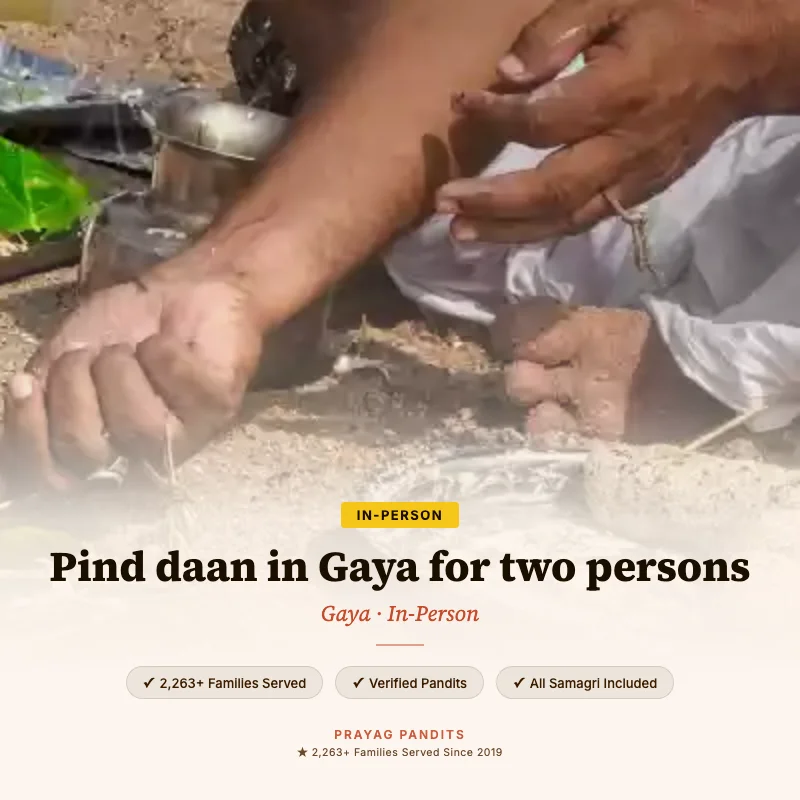
When a family decides to perform Pind Daan together — a husband and wife honoring her in-laws, two siblings fulfilling their duty to departed parents, or a couple seeking the blessings of both their lineages — there is something especially moving about that shared act of remembrance. This package is designed for exactly that: a joint Pind Daan ceremony for two family members, conducted at the sacred ghats of Gaya, on the banks of the Falgu river, with full Vedic rituals performed by an experienced pandit who knows these rites deeply and performs them with complete sincerity.
Gaya is not simply a pilgrimage town. Among all the tirthas in Bharat, Gaya holds a singular position for ancestral rites. The Puranas name it Pitrutirtha — the tirtha of the ancestors — and Lord Vishnu himself, worshipped here as Pitru Devta, is said to preside over the liberation of souls. When two people come together to offer pind here, the merit of that joint offering is considered complete in a way that solitary rites rarely achieve.
The Valmiki Ramayana tells us that it was here, at Gaya, that Lord Rama himself performed Pind Daan for his father, Maharaj Dasharatha. This is not a minor detail — it is the reason that Gaya’s sanctity for ancestral rites is unquestioned across every tradition of Sanatana Dharma. The Vayu Purana, the Matsya Purana, and the Agni Purana all devote entire sections to the glory of Gaya Kshetra, and all of them say the same thing: na gayaya samam tirtham — there is no tirtha equal to Gaya.
The Falgu river, which flows through Gaya, is described in scripture as inherently sacred to the pitrus. Even in its largely dry form today, the river is considered to carry underground currents of sanctified water, and the sand of its banks is used directly in the pind offering. The Vishnupad Temple, built over the footprint of Lord Vishnu, stands at the heart of the Gaya tirtha circuit. Offering pind in the shadow of this mandir carries a weight of tradition that spans thousands of years.
The Gaya Mahatmya section of the Vayu Purana states that ancestors who receive pind at Gaya are freed from all forms of suffering — regardless of the nature of their karma in life. This is the extraordinary compassion embedded in this ritual: it does not discriminate. Any soul, offered pind with sincerity at Gaya, receives the benefit.
For a deeper understanding of why Gaya is considered the foremost tirtha for ancestral liberation, read our detailed guide: The Ultimate Guide to Pind Daan in Gaya.
In most families, the question of Pind Daan arises when a parent passes. The eldest son traditionally performs the rites — but what about the spouse of the deceased? The children who were not born male? The daughter-in-law who loved her mother-in-law like her own mother? Hindu dharma does not exclude any sincere devotee from the act of ancestral remembrance, and at Gaya, both family members can participate fully in the ceremony.
When two people perform Pind Daan together, their combined sankalpa — their combined intention and spiritual dedication — is offered jointly to the pitrus. The scriptural basis for this is found in the Garuda Purana, which describes the joy of ancestors when more than one descendant comes forward to offer them honor. It is said that ancestors who receive pind from multiple family members experience a proportionally greater degree of relief and liberation.
This is especially significant for couples who have lost a parent together, or for siblings who want to fulfill their duty side by side. The joint ceremony also ensures that both family lineages — the maternal and paternal sides — can be honored within a single ritual if the pandit is instructed accordingly at the time of sankalpa.
For those who want to know what actually happens during the ceremony — and what you will be doing, not just watching — here is a straightforward account of the rites as performed at Gaya.
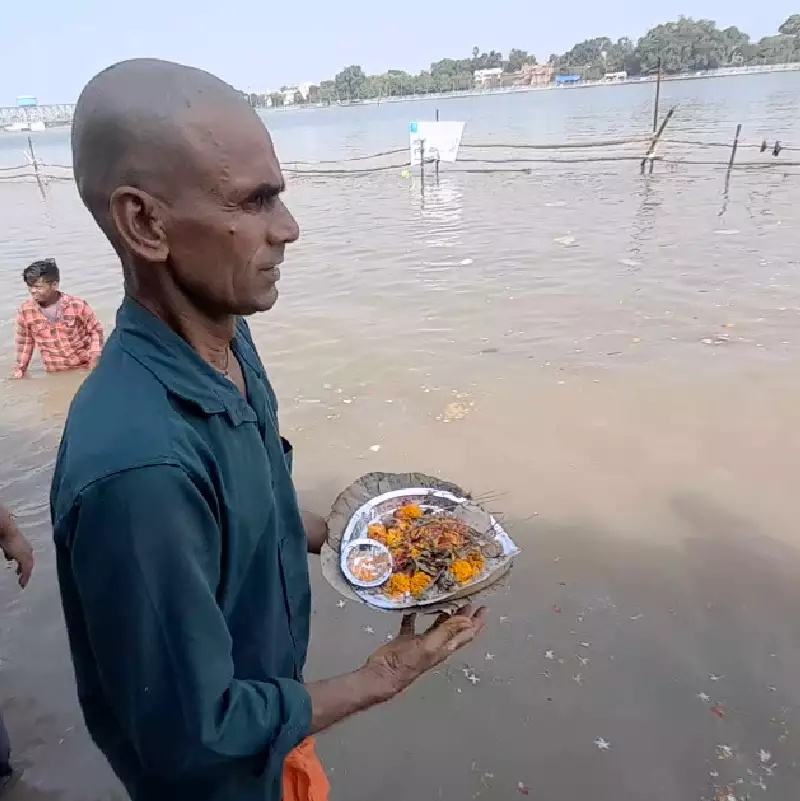
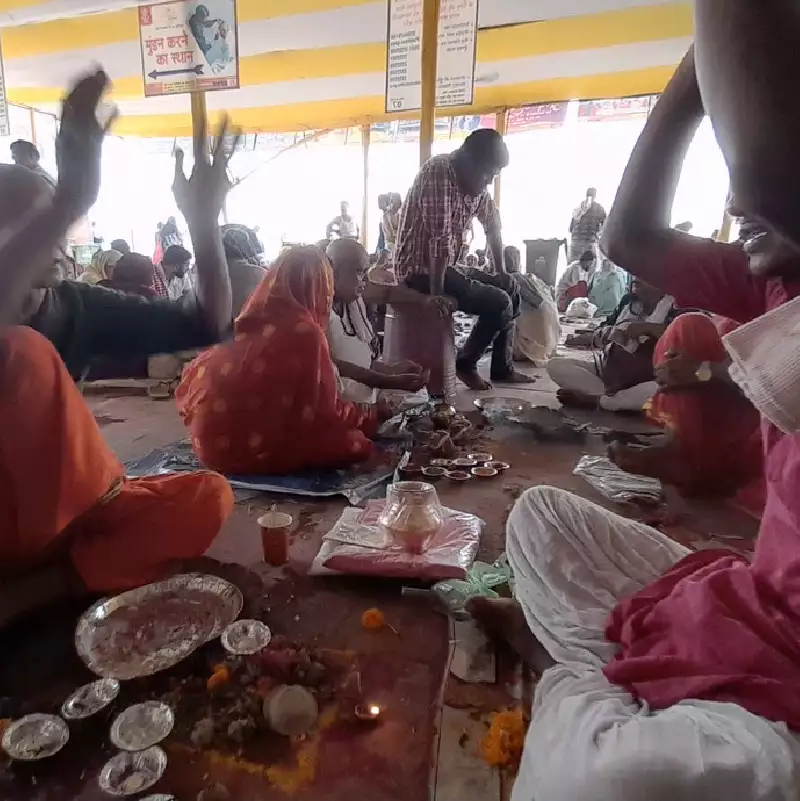
The ceremony begins with a ritual bath at Falgu river. You do not need to immerse fully if the water levels are low; in many seasons, the bath is performed using water drawn from the sacred well near the ghat. This bath is not merely physical — it is a ritual purification that prepares you to enter the space of ancestral communication as a clear vessel.
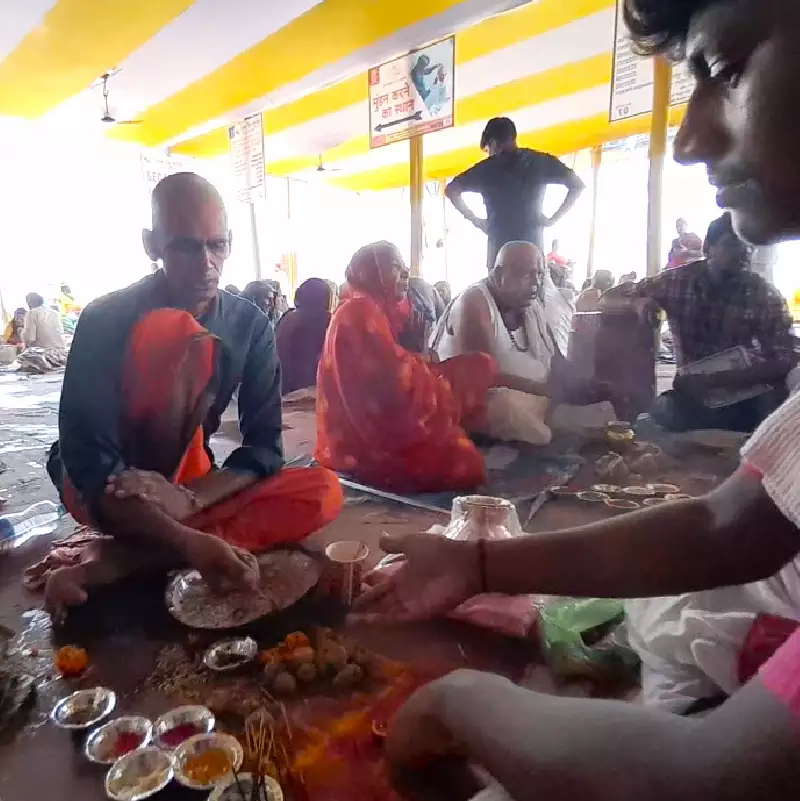
The sankalpa is the formal declaration. The pandit will guide you through reciting the names of your ancestors — typically three generations back on the father’s side and, if intended, on the mother’s side as well. You state your own gotra, your name, and your location. This sankalpa is what connects the ritual to your specific lineage. Both persons performing the rite take the sankalpa together.
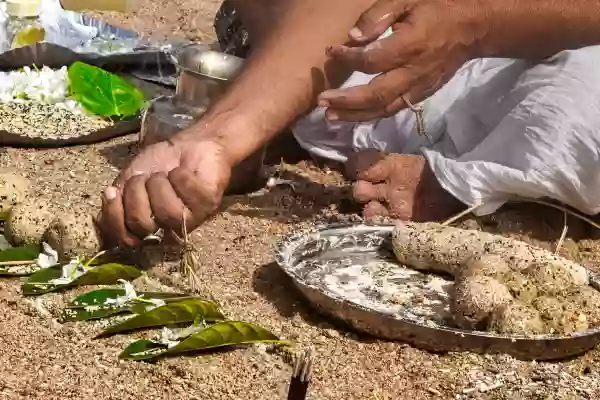
The pind — a ball of cooked rice or barley flour mixed with black sesame seeds, honey, and ghee — is prepared by hand, with intention. You will shape the pind yourself under the pandit’s guidance. The act of using your own hands to form the offering carries significance; this is not something delegated entirely to the priest. You are feeding your ancestors, and the personal contact matters.
Tarpan is the offering of water. Using cupped hands, you pour water mixed with sesame seeds in the direction of the pitrus. The Vedic mantra recited during tarpan addresses ancestors by name and asks them to receive the offering and grant their blessings in return.
The circuit at Gaya typically includes darshan at the Vishnupad Temple, where the footprint of Lord Vishnu is set in solid rock, enclosed in a silver railing. This darshan is considered an essential part of the Gaya rites — it is the moment where the mortal act of ancestral remembrance meets the divine assurance of Lord Vishnu that the offering has been received.
The ceremony concludes with offering of food to the pandit and, ideally, to one or more other Brahmins present, which is considered equivalent to feeding the ancestors directly. The pandit will guide you through the final mantras and the symbolic release — letting the ancestors go forward on their journey, freed by your offering.
For a more detailed explanation of the ritual steps and what each element means, see our complete guide: How to Perform Pind Daan Poojan.
This two-person package is the right choice for any of these situations:
There is no restriction on gender for participation in Gaya Pind Daan. Women can and do perform these rites — Sita herself, according to the Ramayana, shaped and offered pind for Dasharatha during the time she and Ram were in Gaya. If anyone has told your family otherwise, please know that this is not the scriptural position.
We are not a travel company that has added puja booking as a side service. We are a pandit family from Prayagraj whose roots in ancestral rites go back generations. Our pandits who perform Gaya Pind Daan are specialists — they know the Gaya Mahatmya, they know the correct mantras for different gotra lineages, and they know how to make a family feel genuinely cared for during what is often an emotionally tender experience.
Families who have come to us from across India and from abroad consistently tell us the same thing: they were surprised by how personal the ceremony felt. That is because for us, this is not a transaction. Every family that comes to Gaya carries their grief, their love, and their hope with them. The least we can do is match that seriousness with our own.
We are also fully transparent about what is included in the package and what is not, so there are no surprises at the ghat. The price you see is the price you pay. For a complete picture of what Gaya Pind Daan costs across different package levels, see our page on Gaya Pind Daan cost.
Yes, absolutely. There is no scriptural restriction on a wife performing Pind Daan alongside her husband. In fact, the Gaya Mahatmya explicitly mentions that when a husband and wife come together to offer pind, the merit is complete for both their lineages. Our pandit will guide both of you through every step of the sankalpa and the offering.
The traditional Gaya rites include 48 vedis (sacred spots), but the complete circuit takes three days. This package covers the primary rites at the Falgu riverbank and the Vishnupad area — the rites that carry the greatest weight. A longer circuit can be arranged separately if your family wishes to perform the extended version. Please contact us to discuss.
This package covers the ancestral rites for two persons on the sankalpa. However, the sankalpa can be structured to include ancestors from both family lineages — maternal and paternal — in a single ritual. If you specifically need rites for four individually named deceased persons with separate pind offerings, please contact us so we can structure the right ceremony for your family.
You do not need to bring any puja materials — all samagri is included. We ask that you bring clean, simple white or light-coloured clothes for the ceremony. Carry the names and gotras of the ancestors you wish to honor, along with the date of their passing if known. Our pandit will ask for these details during the sankalpa. Nothing else is required.
Pind Daan can be performed at Gaya throughout the year — this is one of Gaya’s unique qualities; it is a tirtha that is always open for ancestral rites. However, the Pitrupaksha period (the 16-day fortnight in the month of Ashwin, which falls in September–October) is considered the most auspicious time. During Pitrupaksha, Gaya is filled with pilgrims from across the country, and the atmosphere of collective ancestral remembrance is deeply moving. Phalgun Amavasya and Amavasya days in other months are also considered very auspicious.